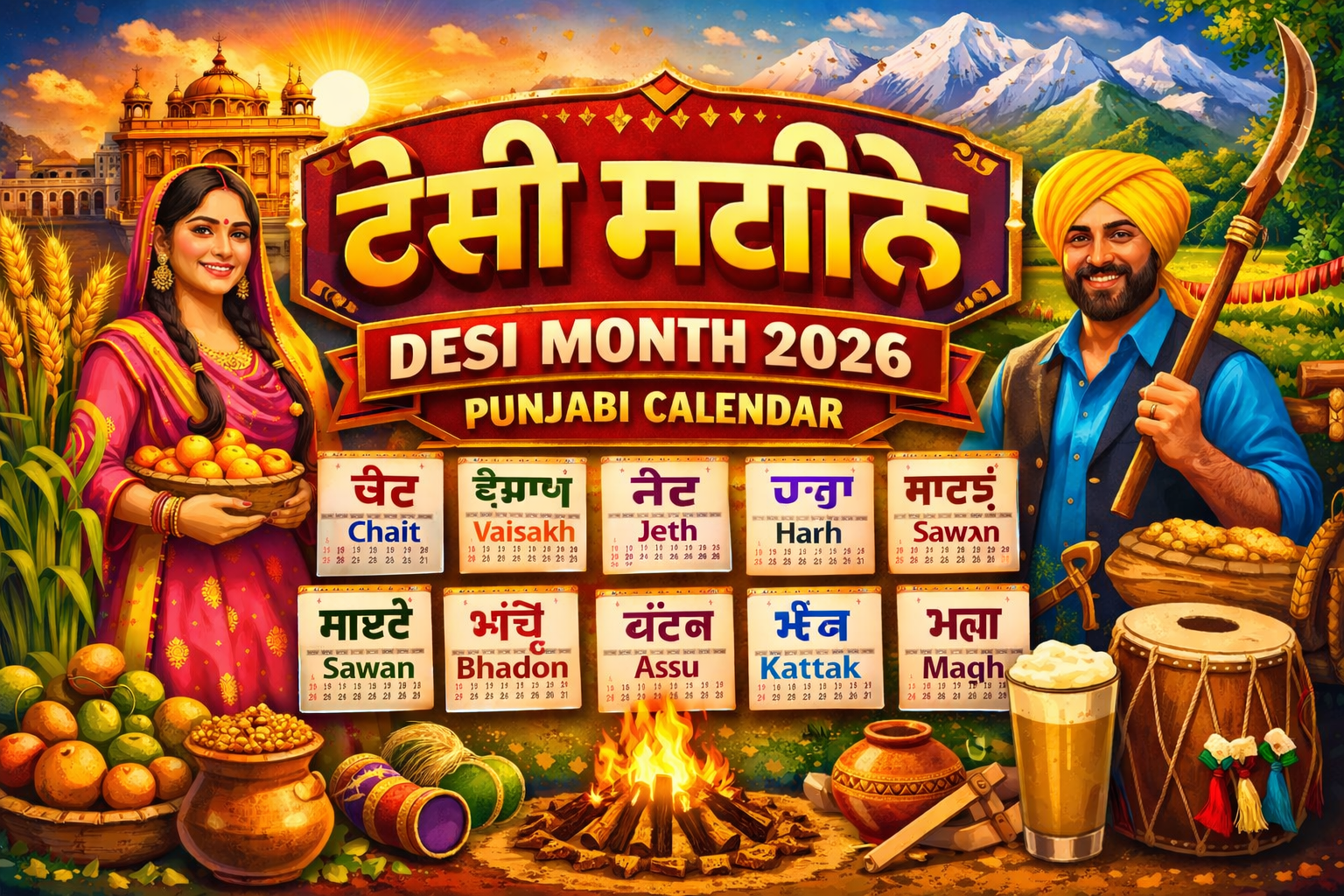
Today Desi Month Date in Pakistan & India 2026
Today is Sunday January 4,2026, but according to the desi calendar, it’s ਐਤਵਾਰAitavāra 21 Poh, Year 2082.
| Desi Punjabi Month | Poh Month Today Date 2026 |
|---|---|
| Today Desi Punjabi Month Date | 21 Poh,پوہ,ਪੋਹ |
| Desi Punjabi Year | 2082 |
| Today | Sunday,ਐਤਵਾਰAitavāraاتوار |
| English Calendar Date | 4-01-2026 |
| Desi Punjabi Month Date In Urdu | آج پوہ دیسی پنجابی مہینے کی تاریخ 21 ہے۔ |
| Desi Punjabi Month Date In Punjabi | ਅੱਜ ਪੰਜਾਬੀ ਦੇਸੀ ਮਹੀਨੇ ਪੋਹ ਦੀ 21 ਤਰੀਕ ਹੈ। |
| Desi Punjabi Month Date In Hindi | आज पंजाबी महीने ‘पोह’ की 21 तारीख है। |
Desi Month January 2026 Dates From Poh To Maagh
| January 2026 | ||||||
| Mon | Tue | Wed | Thu | Fri | Sat | Sun |
| 1 18 Poh | 2 19 Poh | 3 20 Poh | 4 21 Poh | |||
| 5 22 Poh | 6 23 Poh | 7 24 Poh | 8 25 Poh | 9 26 Poh | 10 27 Poh | 11 28 Poh |
| 12 29 Poh | 13 30 Poh | 14 1 Maagh | 15 2 Maagh | 16 3 Maagh | 17 4 Maagh | 18 5 Maagh |
| 19 6 Maagh | 20 7 Maagh | 21 8 Maagh | 22 9 Maagh | 23 10 Maagh | 241 1 Maagh | 25 12 Maagh |
| 26 13 Maagh | 27 14 Maagh | 28 15 Maagh | 29 16 Maagh | 30 17 Maagh | 31 18 Maagh | |
The Desi Punjabi Month Calendar is more than just a way to track days it’s a reflection of a rich cultural heritage that spans across Pakistan and India. This unique calendar, deeply rooted in agrarian traditions, is still used today to mark important festivals, agricultural activities, and cultural events. For anyone looking to explore Punjabi culture or understand the traditional systems that have shaped life in the Punjabi regions, this calendar offers invaluable insights.
The Desi Punjabi Month Calendar, also known as the Nanakshahi Calendar, is a solar calendar used in the Punjab region of India and Pakistan. This calendar is significant for the Sikh community, marking important dates and festivals related to Sikh history and culture. Each month in the Nanakshahi Calendar aligns closely with the Gregorian calendar months but retains traditional Punjabi names such as Chet, Vaisakh, and Jeth. The calendar starts with the month of Chet, which usually begins on March 14. It was established to provide a more consistent and uniform way for Sikhs around the world to celebrate key events, including Gurpurabs, which commemorate the birthdays and martyrdoms of the Sikh Gurus.
Why the Punjabi Calendar Matters?
Understanding the Punjabi Calendar offers insights into the rich cultural tapestry of Punjab. It showcases how deeply intertwined the people are with their land, traditions, and community. For those looking to explore or refine their personal connection to the region, this calendar is a gateway to understanding its soul.
Chet (Mid-March to Mid-April)
Chet marks the beginning of the Punjabi New Year, kicked off with the grand festival of Baisakhi. This is a time of new beginnings, hope, and prosperity. Farmers begin sowing their fields, and the bazaars are filled with the vibrant colors of spring produce. Baisakhi is not just a harvest festival but also a time of thanksgiving, marked by joyous celebrations and communal gatherings.
Vaisakh (Mid-April to Mid-May)
Vaisakh carries forward the Baisakhi fervor with religious processions and rituals, particularly around the Golden Temple in Amritsar. This month marks the start of the solar year in Sikh tradition, drawing devotees from around the world to offer their prayers. The sense of community and spiritual renewal is palpable during this time.
Jeth (Mid-May to Mid-June)
Jeth is synonymous with blistering heat, but it also signifies the onset of mango season. Families delight in the “king of fruits” in various delectable forms. This month also features the important festival of Gurgaddi, honoring the installation of Guru Granth Sahib as the eternal Guru. Despite the heat, the spiritual fervor remains high.
Harh (Mid-June to Mid-July)
Harh brings the much-needed respite of the monsoon season. Lohri festival, which marks the end of the harvest season, is a highlight this month. Folks gather around bonfires, singing and dancing to traditional folk tunes. The arrival of the rains is seen as a blessing, rejuvenating both the land and the people.
Saawan (Mid-July to Mid-August)
Saawan is a month of lush greenery and cool, rejuvenating showers. Dedicated to Lord Shiva, Monday fasts called “Somvar Vrats” are observed to seek the deity’s blessings. The Nag Panchami festival, which honors the snake god, is also a significant event. The entire region comes alive with the vibrant colors of nature and the spiritual fervor of the people.
Bhadon (Mid-August to Mid-September)
Bhadon is a time for major Sikh historical events. It commemorates the controversial partition of Punjab and India in 1947. The month begins with the festival of Teej, a day dedicated to the health and longevity of one’s spouse. Despite the somber remembrance, the community comes together in solidarity and hope.
Assu (Mid-September to Mid-October)
Assu marks the beginning of the autumn season and is significant for the Dussehra festival. This festival symbolizes the victory of good over evil, celebrated with great fanfare. Effigies of the demon king Ravana are burnt in various parts of the region, culminating in a display of communal unity and moral triumph.
Katik (Mid-October to Mid-November)
Katik is the time for the harvest of the Kharif crop and the onset of winter. The month is marked by the observance of Diwali, the festival of lights. Homes are lit with oil lamps, and fireworks light up the night sky. This is a time of joy, prosperity, and familial bonding.
Magh (Mid-November to Mid-December)
Magh is the month of Maghi, celebrated in honor of the Chali Mukte, forty Sikh warriors who died fighting for Guru Gobind Singh Ji. This month also sees the observance of Lohri, dedicated to fire and the sun. The community gathers to celebrate bravery, sacrifice, and the enduring spirit of Sikhism.
Poh (Mid-December to Mid-January)
Poh marks the onset of winter in Punjab, a time of intense cold. The winter solstice is celebrated with the festival of Maghi, acknowledging the sun’s movement into the Capricorn zodiac sign. Despite the cold, the warmth of community and togetherness shines through.
Maghar (Mid-January to Mid-February)
Maghar is a month of hope and courage. Punjabis commemorate their martyrs and celebrate the harvest of the Rabi crop. The month concludes with the festival of Hola Mohalla, a grand military-style event showcasing Punjab’s martial legacy. It’s a time of remembrance, pride, and communal strength.
Phagun (Mid-February to Mid-March)
Phagun ushers in the spring season with the joyous celebrations of Holi, the festival of colors.It marks the end of the Punjabi Desi Month Calendar, completing the cyclical nature of life and festivities in the vibrant Punjabi community.
Celebrating the Cycles of Life
The Punjabi Calendar is more than a way to track dates; it’s a testament to the enduring spirit and vibrant culture of Punjab. Each month offers a unique blend of tradition, celebration, and community, making it a rich tapestry of life.
Desi Punjabi Calendar Days Names List
| Days in English | Desi Days in Punjabi | Days in Urdu |
|---|---|---|
| Monday | Somvaar | سوموار |
| Tuesday | Mangalvaar | منگل |
| Wednesday | Budhvaar | بدھ |
| Thursday | Veervaar | جمعرات |
| Friday | Shukarvaar | جمعہ |
| Saturday | Sanicharvaar | ہفتہ |
| Sunday | Aitvaar | اتوار |
Desi Punjabi Calendar Month Names List
| Punjabi Month | Urdu Names | Gregorian Months |
|---|---|---|
| Chet | چیت | 14 March – 13 April |
| Vaisakhi | بیساکھ | 14 April – 14 May |
| Jeth | جیٹھ | 15 May – 14 June |
| Harh | ہاڑ | 15 June – 15 July |
| Sawan | ساون | 16 July – 15 August |
| Bhadon | بھادوں | 16 August – 14 September |
| Assu | اسو | 15 September – 14 October |
| Katak | کاتک | 15 October – 13 November |
| Maghar | مگھر | 14 November – 13 December |
| Poh | پوہ | 14 December – 12 January |
| Magh | ماگھ | 13 January – 12 February |
| Phagun | پھاگن | 13 February – 14 March |
Sangrand Dates 2026
| Month | Sangrand 2026 | Day of Week | Desi Month |
| January | 14 JAN 2026 | Wednesday | Magh |
| February | 12 FEB 2026 | Thursday | Phagan |
| March | 14 MAR 2026 | Saturday | Chet |
| April | 14 APR 2026 | Tuesday | Vaisakh |
| May | 15 MAY 2026 | Friday | Jeth |
| June | 15 JUN 2026 | Monday | Harh |
| July | 16 JUL 2026 | Thursday | Sawan |
| August | 17 AUG 2026 | Monday | Bhadon |
| September | 17 SEP 2026 | Thursday | Assu |
| October | 17 OCT 2026 | Saturday | Kattak |
| November | 16 NOV 2026 | Monday | Maghar |
| December | 16 DEC 2026 | Wednesday | Poh |
Masya in 2026
| Masya Date | Day of Week |
| 18 January 2026 | Sunday |
| 17 February 2026 | Tuesday |
| 19 March 2026 | Thursday |
| 17 April 2026 | Friday |
| 16 May 2026 | Saturday |
| 15 June 2026 | Monday |
| 14 July 2026 | Tuesday |
| 12 August 2026 | Wednesday |
| 11 September 2026 | Friday |
| 10 October 2026 | Saturday |
| 9 November 2026 | Monday |
| 8 December 2026 | Tuesday |
Puranmashi in 2026
| Puranmashi Date | Day of Week |
| 3 January 2026 | Saturday |
| 1 February 2026 | Sunday |
| 3 March 2026 | Tuesday |
| 2 April 2026 | Thursday |
| 1 May 2026 | Friday |
| 31 May 2026 | Sunday |
| 29 June 2026 | Monday |
| 29 July 2026 | Wednesday |
| 28 August 2026 | Friday |
| 26 September 2026 | Saturday |
| 26 October 2026 | Monday |
| 24 November 2026 | Tuesday |
| 23 December 2026 | Wednesday |
Panchami in 2026
| Panchami Date | Day of Week |
| 23 January 2026 | Friday |
| 22 February 2026 | Sunday |
| 23 March 2026 | Monday |
| 21 April 2026 | Tuesday |
| 21 May 2026 | Thursday |
| 19 June 2026 | Friday |
| 18 July 2026 | Saturday |
| 17 August 2026 | Monday |
| 16 September 2026 | Wednesday |
| 15 October 2026 | Thursday |
| 14 November 2026 | Saturday |
| 14 December 2026 | Monday |
Dashmi in 2026
| Dashmi Date | Day of Week |
| 28 January 2026 | Wednesday |
| 26 February 2026 | Thursday |
| 28 March 2026 | Saturday |
| 26 April 2026 | Sunday |
| 25 May 2026 | Monday |
| 24 June 2026 | Wednesday |
| 24 July 2026 | Friday |
| 22 August 2026 | Saturday |
| 21 September 2026 | Monday |
| 21 October 2026 | Wednesday |
| 20 November 2026 | Friday |
| 19 December 2026 | Saturday |